
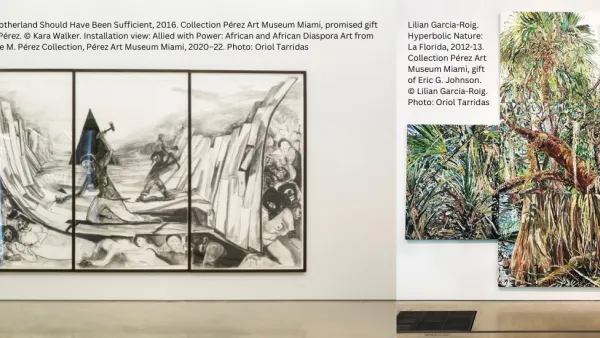
Lilian Garcia-Roig’s landscape paintings overwhelm viewers’ senses with their depictions of forests across the Americas. While these natural spaces reflect the artist’s personal aim to resolve the lacuna between her Cuban and American identities, her ultimate mission is to offer viewers a sense of belonging—which she deems crucial in constructing personal identity.1 Yet, as we shall see, achieving a sense of belonging within these natural spaces challenges discourses of capitalist modernity that suggest, to use critic Jafari S. Allen’s words, “The Americas, constituted as a place of ‘new world’ discovery and conquest, is always already modern. Modernity begins with the invasion and conquest of indigenous Americans and the invasion and forced immigration of Africans.”2 This displacement of ethnic groups, territories, and the resultant erasure of natural landscapes and peoples’ embodied knowledge of those spaces are corollaries of European tendencies to control natural resources and develop urban centers—economic and political urges indicative of capitalist modernity.3 Garcia-Roig’s forest depictions from across the Americas immerse viewers in spaces that are absent of images reflecting European invasion, conquest, displacement, and capitalist motives—factories, urban centers, and shipping ports, among other visual signifiers. These purely natural spaces seem to offer viewers escape routes from the oppressive forces of modernity that displace peoples and their immediate environments. Through portraying these forest landscapes, Garcia-Roig aims to understand how nature can serve as a place of refuge, healing, and belonging.
